
Single-use and syringe-based
Everything that touches the blood is single-use. The working configuration includes:
- Premixed excipient (proprietary polymer solution)
- 30 mL Luer-lock processing syringe
- Excipient draw needle
- Butterfly venipuncture set
- Luer-lock syringe cap
- Female-to-female Luer connector
- Plastic positioning clamp
- Labels and instructions
Working configuration under development; final components, packaging, and sterility claims remain subject to verification. A second sterile 20 mL syringe, supplied by the user, collects the plasma.

1A proprietary polymer solution stacks red cells into rouleaux
The processing syringe is primed with a premixed excipient: a proprietary polymer solution with an anticoagulant. The polymer promotes reversible aggregation of red cells into stacks called rouleaux.
Stokes’ law. Settling speed v rises with the square of particle radius r, so aggregates settle much faster than single red cells. Platelets, far smaller, settle much more slowly.

2The Boycott effect shortens the settling path
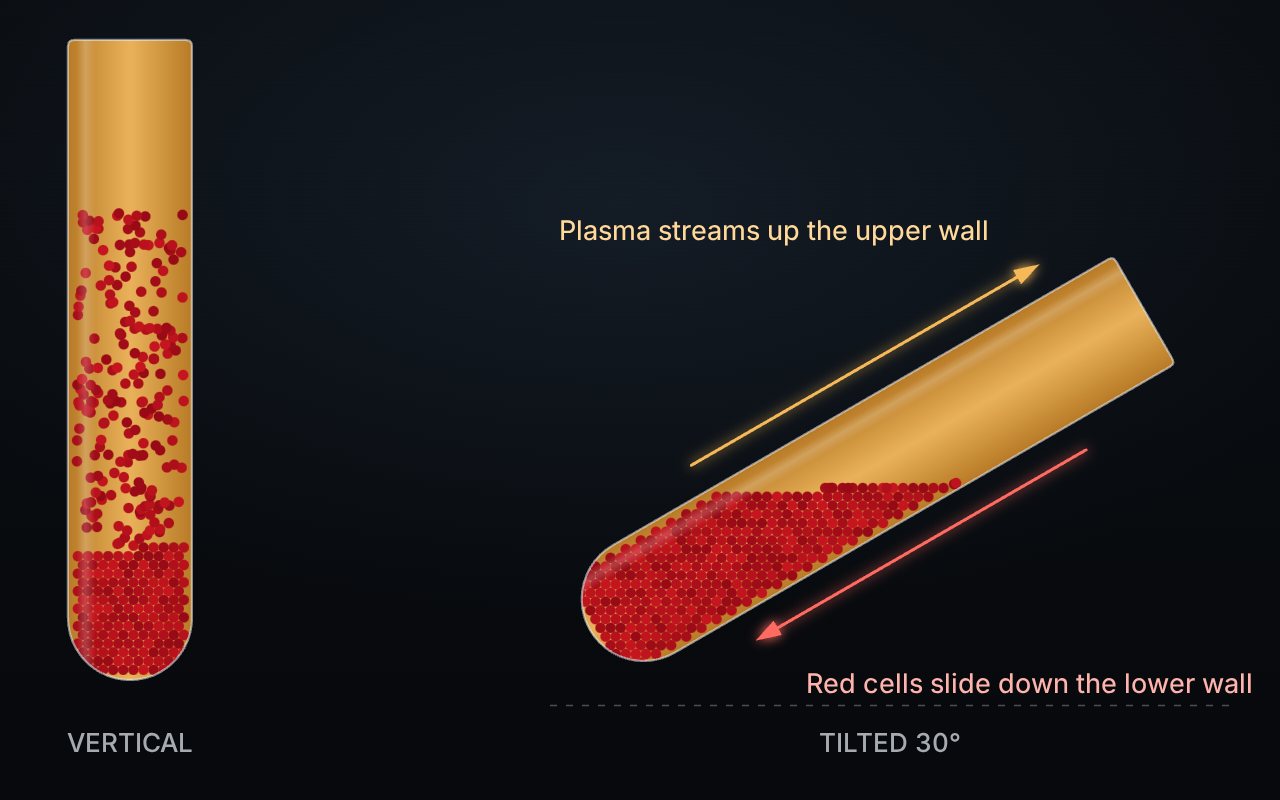
In 1920, A. E. Boycott reported that blood corpuscles settle faster in an inclined tube than in a vertical one.1 Tilted, the cells need to fall only a short distance to reach the lower wall; they slide down it while clarified plasma streams up along the upper wall.
The No Spin PRP® System rests the syringe tip-up at about 30°, held by a positioning clamp on the plunger flange.
3An upper plasma layer, ready to transfer
An upper plasma layer forms above the red cells. Keeping the tip up, the plasma is transferred slowly into a second syringe through a female-to-female Luer connector, stopping before the red-cell interface reaches the connector.
Visual appearance alone does not establish platelet count, function, or sterility.

The working procedure at a glance
Development draft. For research, the approved study protocol governs; parameters are subject to change as development continues.
Draw the excipient
The premixed polymer solution goes into the 30 mL processing syringe.
Collect blood
Venous blood is drawn into the same syringe.
Mix gently
Slow, complete end-over-end inversions. No shaking.
Settle
Tip up at about 30°, undisturbed, for about 30 minutes.
Transfer
The upper plasma layer moves to a second syringe.
What development studies will evaluate
- 01
PRP composition
Cell counts, platelet concentration, and pH of the prepared plasma.
- 02
Platelet function
Activation state and responsiveness of platelets after preparation.
- 03
Bone-graft handling
How PRP–graft mixtures handle compared with appropriate controls.
References
- Boycott AE. Sedimentation of blood corpuscles. Nature. 1920;104:532. doi:10.1038/104532b0